 This web resource that I am writing about today is for those who like the idea of
flashcards and drill of certain skills, but hate taking the time to make them!
Quizlet.com is a site that many teachers know fondly, and it is a great
resource for students inside and outside the classroom. This site is known for
many different uses and content areas, but I’m going to focus on using this
site for a mathematical purpose. For the Quizlet flashcards, children at many ages can work and use the flashcards.
However, these flashcards are probably most functional for students who are age
7 and up. For learning formulas and practicing memorization of the mathematical formulas
and facts, this site is very appropriate for in-school use. There are not any
bad advertisements displayed, and all of the flashcards that you can search for
are all school-appropriate topics. For the specific Quizlet flashcards for
mathematics, there are many content area connections. There are flashcards for
almost every skill in mathematics that students need to memorize or drill
quickly. If the user clicks on “start flashcards,” the flashcards appear one at
a time, and the student can practice while sitting at the computer. The action
of flipping the flashcards and reviewing the mathematical connections is a great
tool for students to use. One con to this resource is that the only interactive
aspect of this site is that the students get to click on the flashcard to flip
it. Thus, there is some small interactive aspect, but there is not a large
interactive aspect to use in the classroom that gets everyone involved for a
long period of time. Luckily, to use the flashcards on Quizlet.com, you do not
have to have a log in and password. You can use the search bar to find
flashcards about a certain mathematical or non-mathematical topic to help
review facts for students of any age!
This web resource that I am writing about today is for those who like the idea of
flashcards and drill of certain skills, but hate taking the time to make them!
Quizlet.com is a site that many teachers know fondly, and it is a great
resource for students inside and outside the classroom. This site is known for
many different uses and content areas, but I’m going to focus on using this
site for a mathematical purpose. For the Quizlet flashcards, children at many ages can work and use the flashcards.
However, these flashcards are probably most functional for students who are age
7 and up. For learning formulas and practicing memorization of the mathematical formulas
and facts, this site is very appropriate for in-school use. There are not any
bad advertisements displayed, and all of the flashcards that you can search for
are all school-appropriate topics. For the specific Quizlet flashcards for
mathematics, there are many content area connections. There are flashcards for
almost every skill in mathematics that students need to memorize or drill
quickly. If the user clicks on “start flashcards,” the flashcards appear one at
a time, and the student can practice while sitting at the computer. The action
of flipping the flashcards and reviewing the mathematical connections is a great
tool for students to use. One con to this resource is that the only interactive
aspect of this site is that the students get to click on the flashcard to flip
it. Thus, there is some small interactive aspect, but there is not a large
interactive aspect to use in the classroom that gets everyone involved for a
long period of time. Luckily, to use the flashcards on Quizlet.com, you do not
have to have a log in and password. You can use the search bar to find
flashcards about a certain mathematical or non-mathematical topic to help
review facts for students of any age! Tuesday, October 29, 2013
Web Resource #2: Quizlet.com
This web resource that I am writing about today is for those who like the idea of
flashcards and drill of certain skills, but hate taking the time to make them!
Quizlet.com is a site that many teachers know fondly, and it is a great
resource for students inside and outside the classroom. This site is known for
many different uses and content areas, but I’m going to focus on using this
site for a mathematical purpose. For the Quizlet flashcards, children at many ages can work and use the flashcards.
However, these flashcards are probably most functional for students who are age
7 and up. For learning formulas and practicing memorization of the mathematical formulas
and facts, this site is very appropriate for in-school use. There are not any
bad advertisements displayed, and all of the flashcards that you can search for
are all school-appropriate topics. For the specific Quizlet flashcards for
mathematics, there are many content area connections. There are flashcards for
almost every skill in mathematics that students need to memorize or drill
quickly. If the user clicks on “start flashcards,” the flashcards appear one at
a time, and the student can practice while sitting at the computer. The action
of flipping the flashcards and reviewing the mathematical connections is a great
tool for students to use. One con to this resource is that the only interactive
aspect of this site is that the students get to click on the flashcard to flip
it. Thus, there is some small interactive aspect, but there is not a large
interactive aspect to use in the classroom that gets everyone involved for a
long period of time. Luckily, to use the flashcards on Quizlet.com, you do not
have to have a log in and password. You can use the search bar to find
flashcards about a certain mathematical or non-mathematical topic to help
review facts for students of any age! 
Saturday, October 26, 2013
Text Set #1: Surface Area and Volume of Three-Dimensional Figures
General Resources for Surface Area and Volume of Shapes
Books:
- Pack It Up: Surface Area and Volume

Chloe Lane
Ages: 12 and up
While the student is reading this book, he/she follows a
student through the process of moving, from packing boxes to decorating a new
bedroom and everywhere in between. Students also calculate the surface area and
volume of rectangular prisms and cylinders using nets during this book. I like
this scenario because it is something that people do almost once in their life,
and it puts it into a great perspective of answering the question, “When will I
ever use this?” I’m not sure if the students will do the calculations during
the reading, but they have that option.
- Ancient Mathematics

Serafina Cuomo
Ages: 16 and up
This book consists of the up-most important mathematics
theorems and discoveries we know of today: The theorem of Pythagoras, Euclid's
"Elements", Archimedes' method to find the volume of a sphere. This
book talks about the ancient mathematics and how they were thought about and
derived during the fifth century BC to
the sixth century AD, with the focus on the Mediterranean region. I think this
is great foundation for students to learn about with mathematics, and it
appeals to the history buffs in our classes. I do not particularly like how it
reaches to other ancient mathematics that I might not cover in my math classes,
but this could be a blessing as well while seeing how math played into the
daily lives and issues during this time.
- Finding 3-D Shapes in New York City
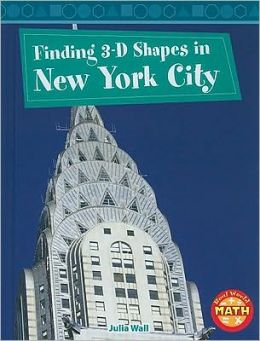
Julia Wall
Ages: 8 and up
Three dimensional shapes are everywhere, and this book helps
students realize that we see and use them every day. The pictures and
situations of skyscrapers, statues, and trees in Central Park are kid-friendly,
real-life situations that show readers how they can put math to work in their
day-to-day lives. A variety of problem-solving activities and graphic
organizers make these books ideal for learners and readers of all ages and
levels. I wish it would have done a non-specific city so students would not be
unfamiliar with New York City, but it is still a fun resource to relate to
lower-level readers.
Websites

- Surface Area Formulas:
http://www.math.com/tables/geometry/surfareas.htm
Ages: 13 and up
Every surface are formula for all three dimensional shapes are given in individual boxes as the students read about what surface area is, what the variables stand for, and gives the reader helpful hints throughout the passage. It isn't just the formulas on a page. This text takes the reader through the material and how each formula is derived. This provides further understanding and helps students outside the classroom lesson.
Ages: 12 and up
This site seems targeted toward younger students, but it actually does a very detailed and thorough job at describing what exactly surface area is and gives students various examples on how to compute surface area. It is easy to read, and it does an excellent job at communicating how to solve these problems step-by-step.
- How to find Surface Area:
Ages: 12 and up
This site seems targeted toward younger students, but it actually does a very detailed and thorough job at describing what exactly surface area is and gives students various examples on how to compute surface area. It is easy to read, and it does an excellent job at communicating how to solve these problems step-by-step.
- Maths Dictionary for Kids:
http://www.amathsdictionaryforkids.com/dictionary.html
Ages: 7 and up
Dictionaries can be overwhelming, but this online dictionary is very kid-friendly and easy to read. On the left hand side, they can click which letter the word they are looking for starts with, and they can find their word in a word bank from there. Clicking on the word brings up the definition, and the student has the option of being more specific with the term, see examples, or use it in a problem. With all of the three-dimensional shapes, students can see how the shape's surface area and volume are computed. This teaches them how to use and be comfortable when it comes to using references and resources, looking up words, and having confidence utilizing them.
- Surface Area and Volume Flashcards:
http://quizlet.com/21623119/new
Ages: 13 and up
Students can go to this website and view the flashcards that are provided. The cards also have lateral area which is great. The cards are for students to practice memorizing and relating which formula goes with what shape. Students can also use this site to create their own flashcards if they need a quick resource. However, students will need to be familiar with the variables and what they represent in the equation.
- Intro to Cell Biology: Surface Area and Volume Relationships:
http://suite101.com/a/intro-to-cell-biology-surface-area-and-volume-relationships-a359072
Ages: 14 and up; Teachers
This article relates the mathematical function of surface area and volume to cells of all living organisms and their overall function. Students want/need to see how this relates outside of shapes, and this is a great example of that. It also gives those students who are interested in medical field, the science of the body, biology, or any other science functions something to enjoy.
- Volume and Surface Area| Geometrical Relationship?
http://mathsisinteresting.blogspot.com/2008/08/volume-and-surface-area-geometrical.html
Ages: 12 and up
Teachers usually get this question when they teach surface area and volume. As a teacher, I don't want to crush their interest or thinking by giving them the answer. Thus, this blog post presents the answer to this question in a fun way while breaking down how the different diagrams can show that the relationship between surface area and volume can be mathematically displayed instead of just students saying, "I think they are...?" It isn't a long post, but it does justice.
- How Much Water is on Earth?
http://ga.water.usgs.gov/edu/earthhowmuch.html
Ages: 14 and up
After learning about surface area and volume of a sphere, lets put this into a real-world perspective. This article informs about the amount of water the Earth holds. It refers this number to volume and the amount of area on Earth the water takes up. Students can learn a lot from this article about our environment, and it puts these mathematical computations into an interesting point of view.
- 3D Objects (Prisms, Cylinders, Cones, Spheres):
http://www.shmoop.com/basic-geometry/three-d-prisms-cylinders-cones-spheres.html
Ages: 12 and up
Without a good understanding of the 3-Dimensional shapes, students have a hard time knowing how to compute surface area and volume. This site gives students clear definitions of the shapes, how they got the name,the sides, faces, etc. After reviewing the definitions, they can go on and look at surface area and volume definitions, as well. It is laid out very well, and students will be more confident during classroom conversations.
- Suface Area Zine:

http://surfaceareazine.com/main/?page_id=261
Ages: 14 and up
This is an art magazine that features graphics artists, and it displays their pieces of self-expression. In some of the articles, it encourages students to draw their own piece of art that meets the surface area dimensions given.
Applications/Interactive Texts
- Interactives: Geometry 3-D Shapes
http://www.learner.org/interactives/geometry/area.html
Ages: 12 and up
From this home page, students can read more information about three-dimensional shapes. Once they feel comfortable with the basic shapes, they have many options to click on that are links in the tool bar. They can look at surface area and volume of the individual shapes, look more at 3-D shapes, visit and learn about Euler's Theorem, and then test their skills. This site gives great text for the students to read, but they might not need to click on all of this information. They do not need to get more confused, but it can also be looked for those students who look for enrichment. This site really breaks down the information on a level that relates to the middle or high school students, and the test your skills is a great interactive to have at the end.
- Measuring a Solid
http://msms.ehe.osu.edu/tag/volume-and-surface-area/
Ages: Teachers
This article from the Ohio State University's College of Education and Human Ecology shares how teachers can use and present how to use surface area and volume in various ways and hands on activities. They are very appealing to students, and they can help students see how these formulas work instead of memorizing them. Some activities are applets, and those might be a little foreign for some teachers if they do not understand what an applet is and how it works.
- Geometry Nets
http://www.kidzone.ws/math/geometry/nets/
Ages: 12 and up; Teacher Resource
Nets can be very abstract to understand how they work, and it is the foundation to understanding three-dimensional objects, their surface area, and their volumes. There are many different three dimensional shapes, and this site offers printable nets for students to build, and it gives a great introduction of what nets are and why we use them. The text is student friendly, but it also is talking to the teacher audience which can be confusing if the reader is a student.
Wednesday, October 23, 2013
Reflection # 8: Academic Vocabulary
Academics vocabulary (or better known as content-specific vocabulary) is the set of words that are seen or communicated in certain academic courses. There are many different names for academic vocabulary, but they all talk about the basic terms used to communicate in contents.
From this article, the authors talk about how academic vocabulary is important, but there are many other categories that academic vocabulary breaks down into. Words can be domain specific, but other vocabulary words can be used cross-curricular. What one word means in math class could mean something different in biology or chemistry. These general academic vocabulary terms appear a lot of the time, and students have to make the distinguish between the two or three meanings. After all of the research, the authors broke down academic words into their own set of five categories. I think theirs it a little more intense due to the addition of metalanguage, but I think this is a very thorough way of deciphering the words and their make up.
While I was reading this article, I was hooked by the name. I love talking and reading about my content's vocabulary terms. However, as soon as I started reading, I started reflecting on the vocabulary I teach my students. I expect them to know the terms, but I tend to forget that they have another meaning engrained into their minds due to past courses and teachers in mathematics or other non-mathematics academic courses. I need to be more understanding of their confusion and lack to memorize new terms in a short time of exposure. I also started thinking about a new kind of vocabulary that teachers and students are learning to incorporate and answer. COMMON CORE VOCABULARY. The students need to know whether they are explaining, comparing, discussing, etc. I think this is another set of general academic vocabulary that I would incorporate in my personal break down of the overall academic vocabulary topic.
Vocabulary is so important, and we must teach it well not only in our content; we need to expose students to the different vocabulary terms whether they are specific or general and not shun their multiple knowledge due to cross-curricular use of certain words. This just gives us a chance to make connections!
Wednesday, October 16, 2013
Reflection #7: Meaning Vocabulary
In any content area and any level, vocabulary is a main
component in lessons and more importantly, conversations. This is why
vocabulary is an essential key to success. If students are going to communicate
with us and listen to our instruction, they need to know the terms. This is an
issue I’m having in my class, and this is why I was so thankful and excited to
read this article, Meaning Vocabulary.
The authors of this chapter laid out seven specific strategies to help students
develop their vocabulary skills and knowledge. Out of these seven, I really
gravitated toward a few of the strategies: List-Group-Label, Feature Analysis, Word
Mp, and Vocabulary Self-Collection Strategy. I liked these due to the fact that
I could see these strategies being the most appealing to my students, but also,
these have a realistic implementation to the daily lesson and classroom. As I
read the other strategies, Possible Sentences, Contextual Redefinition, and
Levin’s Keyword Method, they seemed as if they would be very abstract in a
mathematical class. I think these all would work great in an English or Reading
class where students can make these redefinitions and possible sentences, but I
think some strategies are content sensitive.
 Overall, I think this chapter was
very useful, and I think I can use some strategies to help my students. I think
the authors broke each strategy down in a very helpful way for the reader to
see how each strategy would work, who the strategy is targeted at, and what
purpose each strategy serves. Hopefully with these new strategies in my repertoire,
my students will be able to converse with me and understand what I am saying!
Overall, I think this chapter was
very useful, and I think I can use some strategies to help my students. I think
the authors broke each strategy down in a very helpful way for the reader to
see how each strategy would work, who the strategy is targeted at, and what
purpose each strategy serves. Hopefully with these new strategies in my repertoire,
my students will be able to converse with me and understand what I am saying!

Thursday, October 10, 2013
Reflection #6: Strategies for Critical Reading
Too many times, students will read a passage or text and will take it at face-value. They do not

typically have feelings about an academic text, cannot decipher text from truth or fallacy, and do not criticize readings. In this chapter from Bean, Baldwin and Readence, the authors provide strategies that help scaffold the process of reading critically. The four strategies listed in this chapter are Polar Opposites, Opinion-Proof, REAP, and Phony Document Strategy. Each has their own complexity and their own timing as to when to implement the strategy, but taking the time to do these could really help students become more critical when it comes to reading. They need to be on the lookout for what they are reading or being told is valid. We are teaching students today to not always trust what their teachers say. The students need to question, be skeptical at times, and be on their toes when listening to their teachers. Well, the same aspects apply to reading. Anything can be written and printed. However, it takes a keen reading and student to think about if the information is real or just a bunch of fluff.
After reading this, I think that these activities are great. However, I'd love to see how these could be implemented in more than one domain. I think I could use this in my classes, but I would not stress this as much as perhaps an English or reading teacher would.
Skills in critical reading are essential to be a functioning citizen in our country. Anyone will and can feed us lies, and we need to be aware of this. These skills are essential not only for being successful academically but for life.
Saturday, October 5, 2013
Reflection 5: Chapter 6 Holding Thinking
In this chapter of "Do I Really Have to Teach Reading," Tovani talks about how important it is for students to use their own thinking while they are reading throughout the entire text or passage. She shares that it is not just about using a highlighter to highlight text that is important to us as we read, but it is more about asking questions while reading that grab our attention. There are different ways of thinking about the text and what questions might arise while reading, but it is more than copying what the author gives the reader. I think the opening of this chapter was great with the activity she used to describe how students should be thinking while reading text, but most specifically in the case, pictures. Too many times, we take a picture or text and run with it without assessing the rest of the entry. If we can teach students how to carry their thinking while reading, they will have a more quality experience with reading the harder texts they are exposed to at the upper level of education. As mentioned earlier, it is not necessarily about rewriting the text. I am glad she made this point throughout the chapter! It's about asking the questions and trying to find the answer to these questions in the text as the students read. This is how thinking is held and carried out for many students. There are many tools that can be used to help students hold their thinking while they are reading: write on the page where the questions occur, respond to the text, use sticky notes, slow down while reading, etc.
This chapter tells the reader that teaching students how to think while reading is doable, and it can really open their minds up to reading passages that they would typically not respond to at all. Students need to be taught how to show their thinking in ways that can be seen on paper and not necessarily in their heads. We need to see the thought process and questions that students have while reading so we can discuss and perhaps answer them. With this chapter, I've learned that sometimes, students need to be shown what I'm expecting before I tell them to just jump right in. They need some direction and guidance when it comes to asking them to perform something in a new way that they thought was impossible before.
I definitely think that this chapter can be applied to my mathematics content. I think it is so important for students to ask questions in mathematics to really understand the content and what is being presented. It is new material, and if they can read their notes and textbook while having their own thinking in mind, then we could have some really great conversations and clear up many misconceptions they have. The hard part is having them get comfortable with questioning the textbook, but I think this goal of thinking while reading is obtainable when taught how to properly perform it.
Subscribe to:
Posts (Atom)